6 Ventilation Steps to Treat Powdery Mildew
The scent of damp, anaerobic soil often signals a failure in gas exchange before the first white mycelium appears on a leaf surface. When relative humidity exceeds 60 percent in a stagnant canopy, the Erysiphales fungi exploit the lack of airflow to penetrate the host epidermis. Maintaining leaf turgor and structural integrity requires a rigorous approach to airflow management. These specific steps for treating powdery mildew with ventilation focus on disrupting the microclimate that allows fungal spores to germinate. By increasing the velocity of air around the phyllosphere, you reduce the boundary layer of moisture that clings to the foliage. This process forces the plant to regulate its stomatal conductance more effectively. Strategic ventilation is not merely about cooling; it is a mechanical intervention that prevents the settlement of conidia. Achieving a constant air turnover rate of at least one full volume change every minute is the standard for high-density horticultural environments. This guide details the mechanical and biological protocols necessary to arrest fungal progression through environmental control.
Materials:

Effective ventilation begins with a substrate that does not contribute to excessive humidity through waterlogging. Utilize a **friable loam** with a **Cation Exchange Capacity (CEC) of 15 to 25 meq/100g** to ensure nutrient retention without compaction. The soil pH must remain between **6.2 and 6.8** to optimize the uptake of calcium, which strengthens cell walls against fungal penetration. For the vegetative phase, select a fertilizer with an **NPK ratio of 3-1-2** to promote structural growth without the soft, succulent tissue caused by excessive nitrogen. During the reproductive phase, transition to a **1-2-2 ratio** to support fruit or flower development. Essential hardware includes **oscillating fans capable of 300 CFM**, an **inline centrifugal fan**, and a **digital hygrometer** calibrated to a +/- 2 percent accuracy range.
Timing:
In Hardiness Zones 5 through 8, the primary window for powdery mildew outbreaks occurs when daytime temperatures sit between 70 and 80 degrees Fahrenheit followed by cool, humid nights. Monitor your local frost-date windows; the transition from the vegetative stage to the reproductive stage is the most critical period for ventilation adjustments. As the plant enters senescence, its natural immune response slows down. You must increase airflow during this biological shift to compensate for the plant's reduced metabolic defense. In indoor or greenhouse settings, the photoperiod must be synchronized with ventilation cycles. Fans should remain active during the dark cycle to prevent the "dew point" from being reached as temperatures drop, which would otherwise allow moisture to condense on the leaf surface.
Phases:

Sowing and Initial Airflow
Begin ventilation the moment the first true leaves emerge. Seedlings require a gentle, indirect breeze to stimulate thigmomorphogenesis, which is the strengthening of plant tissue in response to mechanical sensation. Keep the air speed at the canopy level below 50 feet per minute to avoid desiccation of tender tissues.
Pro-Tip: Air movement at this stage prevents the buildup of stagnant CO2 in the boundary layer. This ensures that the photosynthetic rate is not limited by gas diffusion, leading to thicker stems and more resilient vascular systems.
Transplanting and Spacing
When moving plants to their permanent location, adhere to a spacing of at least 18 to 24 inches between centers. This gap ensures that air can circulate through the lower third of the canopy. Use a hori-hori knife to ensure the root ball is set at the correct depth, preventing stem rot at the soil line.
Pro-Tip: Proper spacing utilizes the Bernoulli principle; as air moves through the narrower gaps between plants, its velocity increases. This natural acceleration helps strip away excess moisture from the underside of leaves where spores often hide.
Establishing and Pruning
Once the plant is established, use bypass pruners to remove the "sucker" growth and internal foliage that blocks light and air. Focus on the interior of the plant to create a "chimney effect" where air can rise through the center. Aim for a Leaf Area Index (LAI) that allows light to fleck the soil surface at midday.
Pro-Tip: Pruning suppresses apical dominance and redirects auxins to lateral branches. Biologically, this creates a more open architecture that is inherently less susceptible to the high-humidity microclimates that favor Erysiphales colonization.
The Clinic:
Physiological disorders often mimic fungal infections or exacerbate them. Observe the following symptoms to differentiate between environmental stress and pathogen attack.
- Symptom: Interveinal chlorosis on older leaves.
Solution: This indicates a Magnesium deficiency. Apply a foliar spray of 1 tablespoon Epsom salts per gallon of water to restore chlorophyll production. - Symptom: Leaf margins curling upward (canoeing).
Solution: This is a sign of transpiration stress caused by excessive wind or low humidity. Reduce fan speed or increase the distance between the fan and the canopy. - Symptom: White, flour-like spots on upper leaf surfaces.
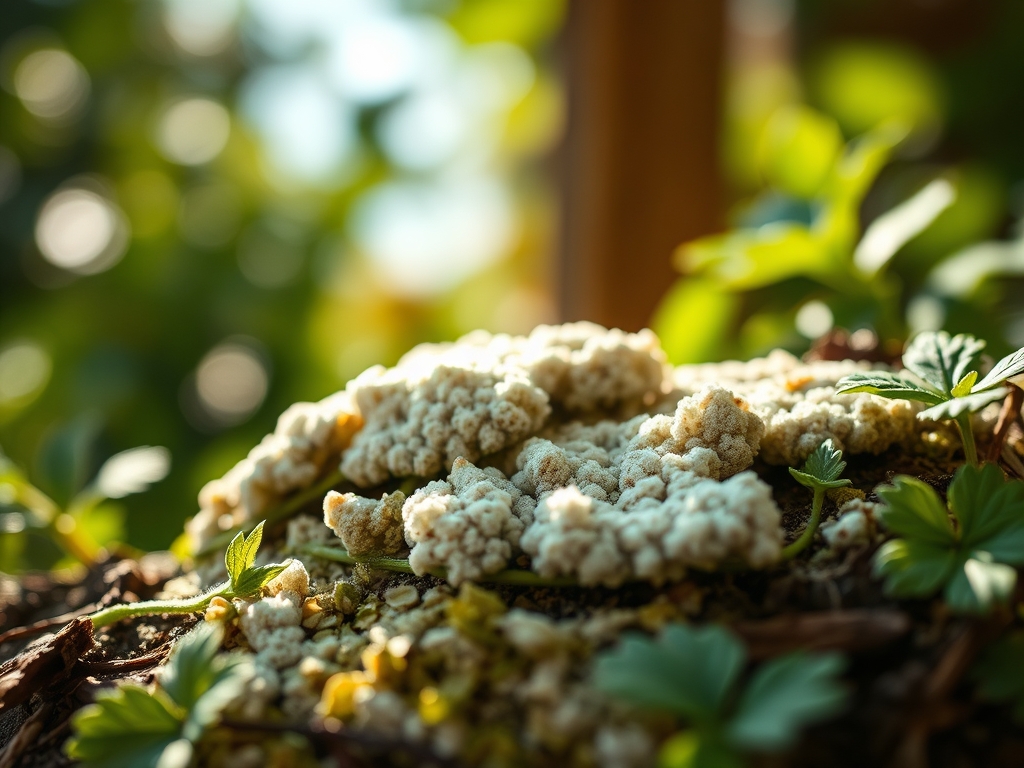
Solution: This is the primary sign of powdery mildew. Immediately increase exhaust fan speed to lower the Relative Humidity (RH) below 50 percent. - Fix-It for Nitrogen Chlorosis: If young leaves are pale green or yellow, the plant lacks Nitrogen. Supplement with a high-Nitrogen fish emulsion (5-1-1) to restore the nitrogen flush required for vigorous growth.
Maintenance:
Consistency is the foundation of fungal prevention. Use a soil moisture meter to ensure the substrate remains at a "moist but not saturated" state; typically level 4 or 5 on a standard 10-point scale. Deliver 1.5 inches of water per week at the drip line, avoiding any contact with the foliage. Check the tension of fan belts and clean the blades of your oscillating fans every 30 days to maintain maximum CFM output. Use your bypass pruners weekly to remove any yellowing or senescing leaves, as these are the first entry points for opportunistic fungi. If you detect a localized infection, use a hori-hori knife to remove the entire plant if the infection exceeds 30 percent of the leaf area to protect the rest of the crop.
The Yield:
Harvesting should occur when the plant reaches its peak secondary metabolite production or optimal sugar content. For most fruiting crops, this is indicated by a color change and a slight softening of the fruit wall. Use sterilized bypass pruners to make clean cuts, leaving a small portion of the pedicel attached to prevent moisture loss. Post-harvest, move the yield immediately to a cooling area with a temperature of 55 degrees Fahrenheit and 60 percent humidity. This "pre-cooling" phase removes field heat and slows down the respiration rate, preserving the crispness and nutritional density of the harvest for "day-one" freshness.
FAQ:
How does ventilation stop powdery mildew?
Ventilation lowers relative humidity and disrupts the boundary layer of air on leaf surfaces. This prevents the high-moisture conditions required for conidia germination. Constant airflow also physically prevents spores from settling on the host tissue.
What is the ideal humidity to prevent mildew?
Maintain relative humidity between 40 and 55 percent. Powdery mildew thrives when humidity exceeds 60 percent. Using an exhaust fan to pull humid air out while bringing in dry air is the most effective mechanical control.
Can fans be too strong for plants?
Yes. Excessive air velocity causes windburn and desiccation. If leaves are flapping violently or curling at the edges, the air speed is too high. Aim for a gentle rustle of the leaves to ensure gas exchange without stress.
Should I run fans at night?
Yes. Temperatures drop at night, which increases relative humidity. Running fans during the dark cycle prevents the air from reaching the dew point, ensuring that moisture does not condense on the foliage and trigger fungal growth.